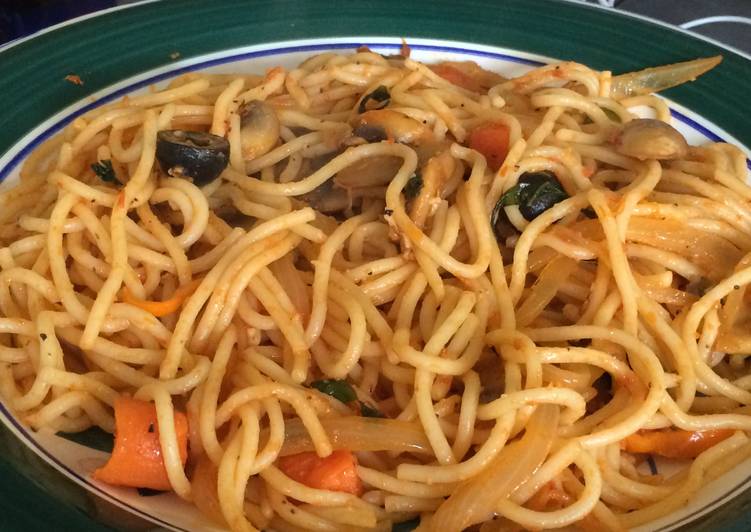
Hello everybody, I hope you’re having an amazing day today. Today, I’m gonna show you how to make a special dish, neapolitan spaghetti. It is one of my favorites. This time, I will make it a little bit tasty. This will be really delicious.
Spaghetti Neapolitan sounds like Italian food from its name, but it is a quite Japanese food. Spaghetti Neapolitan is spaghetti pan-fried with onion and bell pepper, and seasoned with ketchup. One of the most typical dishes of the Campania region or more specifically of Naples, spaghetti allo scarpariello is a simple yet super flavorful pasta dish rich with history and.
Neapolitan spaghetti is one of the most favored of recent trending foods on earth. It is enjoyed by millions daily. It is easy, it is fast, it tastes delicious. They are nice and they look fantastic. Neapolitan spaghetti is something which I have loved my whole life.
To begin with this particular recipe, we must prepare a few ingredients. You can have neapolitan spaghetti using 14 ingredients and 5 steps. Here is how you can achieve that.
The ingredients needed to make Neapolitan spaghetti:
- Take 400 grams Crushed tomatoes
- Prepare 100 grams Grated Parmesan
- Make ready 100 ml Olive oil
- Make ready 10 Black olive
- Prepare 2 tsp Fresh basil
- Prepare 2 tsp Ground Black pepper
- Take 1 large Onion
- Take 500 grams Spaghetti
- Prepare 1 tsp Butter
- Make ready 1 tbsp Salt
- Prepare 1/2 tsp Parsley
- Make ready 1/2 tsp Chopped Garlic
- Get Carrot (optional)
- Make ready Mushroom( optional)
Although its advisable to make the chicken sauce at the last minute, you can make the tomato sauce in advance, refrigerate & reheat. The chicken sauce tastes as good made with half & half but it takes longer to thicken. Napoli residents stroll by or just pass the time in front the huge, green, ancient doors that look upon the diners just across the way along Via Paladino Giovanni. Napolitana Sauce (Neapolitan Sauce) recipe is an authentically made sauce from Naples,Italy.
Instructions to make Neapolitan spaghetti:
- Put water on the stove, add 1/2 teaspoon of butter and 1 teaspoon of salt. Wait until the water boil to add the spaghetti. Wait for about 10-15 minutes and check to see if the spaghetti are ready and remove them from the stove and put them in a plate or a bowl.
- Cut the onions, the basil and the carrot if you choose to add some carrots. Remember the carrot is optional.
- Put the stove on high. In a large pan, add the olive oil and wait for 2 minutes. Add the opinions, the carrot and the crushed tomatoes and stir everything. Reduce the stove to medium and Wait for about 5 minutes.
- After 5 minutes add the chopped garlic, parsley, basil, the black olives, and the black pepper as well as the salt. And wait 3 minutes
- Add the spaghetti and mix it well with the sauce and wait again for 3-5 minutes. Then add the Parmesan. Mix everything for about 2 minutes and voila! It's ready. Bon appétit !
Because of the slow cooking, this sauce creates a deep rich tomato flavor with sweet undertones that is delicious on pasta, pizza, meatballs, etc. Napolitan Spaghetti This pasta dish was created at the New Grand Hotel in Yokohama, Japan, after World War II to cater to American GIs and soon became a mealtime favorite across the rest of the. Spaghetti napolitan, also known as spaghetti naporitan, is a Japanese style pasta dish made with a sauce that is tomato ketchup based. This particular style of Japanese pasta is considered "yoshoku" cuisine, or western cuisine with unique Japanese influences. This simple Neapolitan pasta sauce is delicious and so easy to make!
So that’s going to wrap this up with this special food neapolitan spaghetti recipe. Thank you very much for your time. I am sure that you will make this at home. There is gonna be interesting food in home recipes coming up. Remember to bookmark this page in your browser, and share it to your family, friends and colleague. Thank you for reading. Go on get cooking!